Selected Research Interests
|
TMS In Depression
A considerable proportion of the research I have conducted has been dedicated towards the development and improvement of repetitive transcranial magnetic stimulation (TMS) in the treatment of depression. This research began 20 years ago with studies dedicated towards helping establish whether TMS methods were effective: usually by comparing these to a placebo or sham treatment. The research also has had a major focus on evaluating alternative forms of TMS. Studies were conducted that established that low frequency right-sided TMS is an effective antidepressant treatment, that bilateral TMS could be used effectively but that it was no more effective than unilateral stimulation and that established the effectiveness of ‘priming’ TMS. In more recent year my research program has conducted the most definitive exploration of the effect of TMS dose on clinical outcomes and developed and tested several intensive or accelerated TMS treatment approaches, showing that these can be as effective as standard TMS stimulation. An additional interest of our research program has been in exploring whether modern neuroscience tools can be used to improve clinical outcomes. In the first application of this, we showed that TMS outcomes were improved if the stimulation site was localized using MRI scanning. More recently studies have been conducted which have indicated that certain forms of MRI scanning as well as recordings of electrical brain activity with electroencephalography (EEG) can potentially be used to predict the outcome of TMS therapy. Studies are continuing to be conducted in this area. We’re currently continuing to explore the use of accelerated forms of TMS as well as considering how individualization of therapy based on EEG recordings can be used to optimize clinical outcomes. |
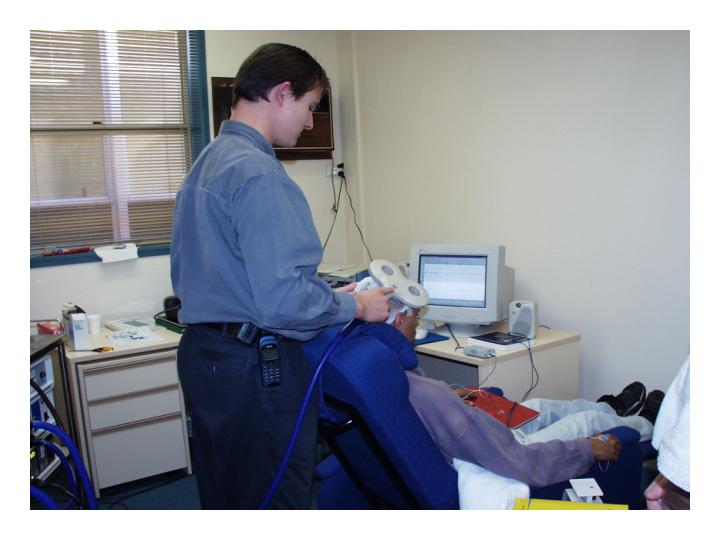
Doing TMS treatment with a hand held coil in 2002
|
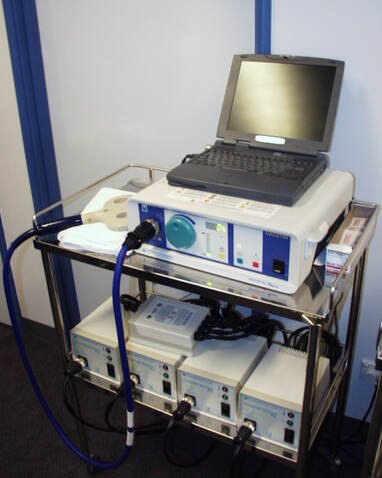
Our first TMS treatment machine
|
TMS in Other Disorders
My research program has also had a significant interest in the development of TMS as a treatment for several other mental health and brain disorders. This began with my interest in the use of TMS in the potential treatment of patients with schizophrenia: studies were conducted exploring the use of the treatment in managing persistent auditory hallucinations (voices) and the negative symptoms experience by some patience with this condition. Studies have been conducted within our group exploring the application of TMS is several other disorders. These have included using TMS to try and improve the social cognitive problems experienced by individuals with autism spectrum disorder, trying to improve pain in fibromyalgia and trying to lessen the symptoms experienced by patience with post-traumatic stress disorder (PTSD) and obsessive compulsive disorder (OCD). The research has also extended to trying to improve cognition in patients with Alzheimer’s disorder. TMS is not applied in the same way across all of these disorders: it is not a matter of a ‘one size fits all’ approach. Data from neuroimaging and other studies is used to establish individual treatment targets and new therapy approaches developed from this. |
|
Using Brain Stimulation and Neuroscience tools to improve our understanding of Neuropsychiatric Disorders
We continue to lack a well developed understanding of the brain processes that underlie conditions such as schizophrenia and depression. Another substantive component of our research program trying to use tools such as transcranial magnetic simulation in combination with neuroimaging and electrophysiology (EEG) to try to provide insights to help us understand these conditions better. This has included an extensive series of studies using TMS methods to demonstrate problems in cortical inhibition and cortical plasticity in patients with schizophrenia and mood disorders. To do this, studies required the development of novel techniques combining TMS with EEG and near infrared spectroscopy. |
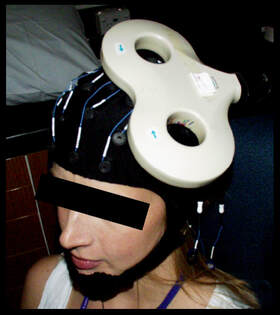
Set up for an early TMS-EEG experiment
|
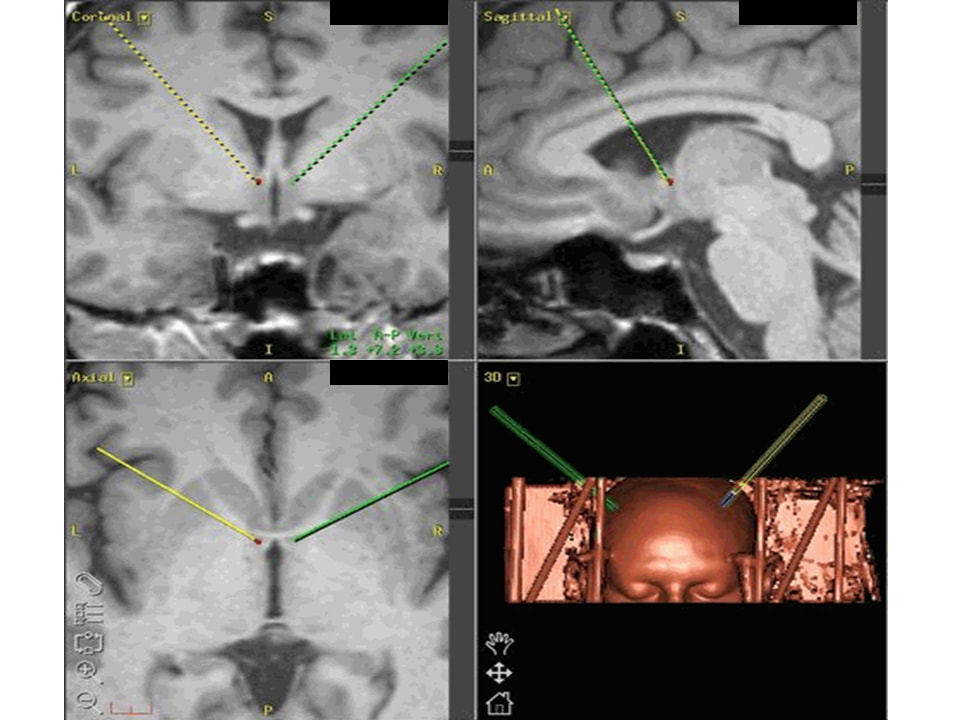
Screenshot from DBS planning software
|
Developing other Brain Stimulation Approaches in the Treatment of Mental Health Conditions
Beyond the use of TMS, an expanding focus of the research within my team has been on the development of other forms of brain stimulation in relation in the treatment of depression and other conditions. This has included conducting some of the first pioneering clinical trials of Magnetic Seizure Therapy, a potential replacement or alternative to electroconvulsive therapy. It has included developing and evaluating the use of the deep brain stimulation applied to the bed nucleus of the stria terminalis in the treatment of severe refractory depression. In addition, my team has been involved in a series of experimental studies and clinical trials helping to evaluate the antidepressant and pro-cognitive effects of transcranial direct current stimulation (tDCS). This has included conducting some of the first studies showing the substantial benefits of combining tDCS with engagement in cognitive tasks, both when tDCS is being used as an antidepressant strategy or an approach to improve cognitive function. |
|
Transcranial alternating current stimulation: a potent approach for the future?
My team has a significant interest in the development of transcranial alternating current stimulation (tACS) as a way of therapeutically improving brain function. tACS is a form of electrical stimulation where the weak electrical current used to stimulate the brain is applied in an alternating (regularly varying) frequency. Importantly, tACS can be highly individualized by applying stimulation at a frequency that matches some aspect of characteristic of the subjects condition or intrinsic brain activity. My team is engaged in series of studies investigating the use of more personalized forms of tACS in the treatment of mental health conditions. We also interested in developing new technology to allow personalized tACS to be provided in a more effective manner, especially in a manner that would allow fully home-based treatment. |
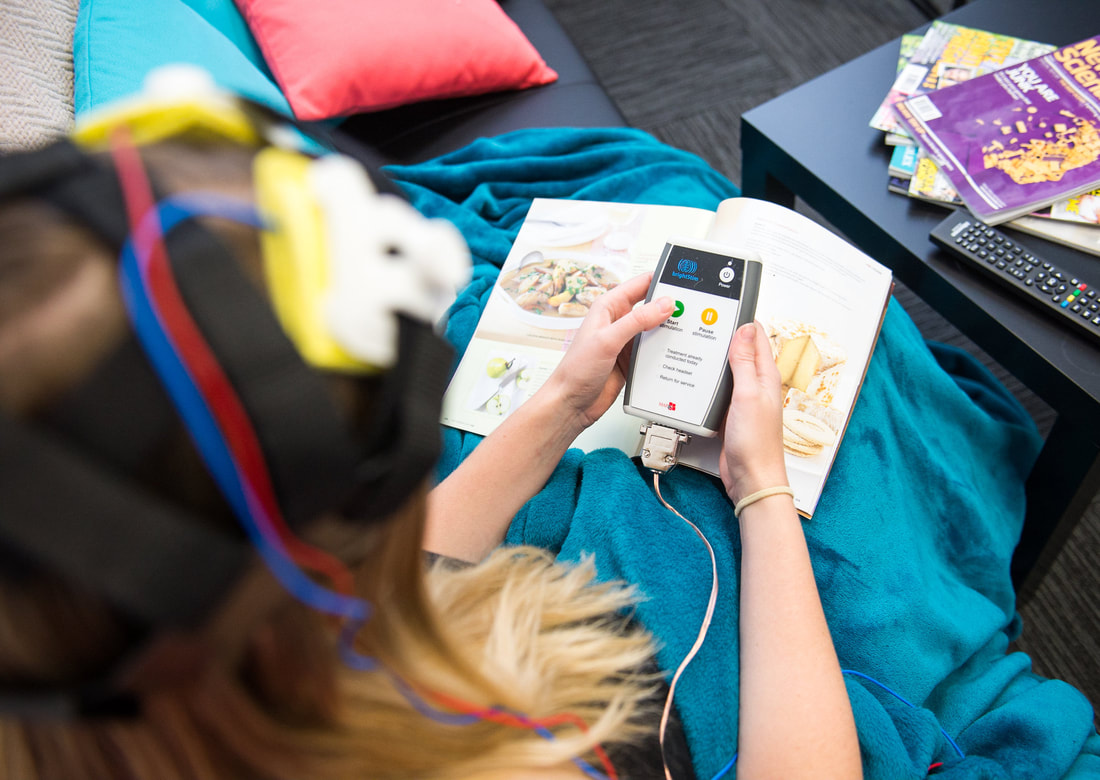
Our BrightStim home use tACS device
|
Selected Recent Publications (2019-)
1. Fitzgerald PB. Response to: Do we need to know more about repetitive transcranial magnetic stimulation in the treatment of depression? Australian and New Zealand Journal of Psychiatry. 2019: 53: 948-949
2. Fitzgerald PB. Is maintenance repetitive transcranial magnetic stimulation for patients with depression a valid therapeutic strategy? Clinical Pharmacology & Therapeutics, in press accepted June 2019
3. S. Tremblay, N. C. Rogasch, I. Premoli, D. M. Blumberger, S. Casarotto, R. Chen, V. Di Lazzaro, F. Farzan, F. Ferrarelli, P. B. Fitzgerald, J. Hui, R. J. Ilmoniemi, V. K. Kimiskidis, D. Kugiumtzis, P. Lioumis, A. Pascual-Leone, M. C. Pellicciari, T. Rajji, G. Thut, et al., “Clinical utility and prospective of TMS–EEG,” Clin. Neurophysiol., 2019.
4. N. W. Bailey, K. E. Hoy, N. C. Rogasch, R. H. Thomson, S. McQueen, D. Elliot, C. M. Sullivan, B. D. Fulcher, Z. J. Daskalakis, and P. B. Fitzgerald, “Differentiating responders and non-responders to rTMS treatment for depression after one week using resting EEG connectivity measures,” J. Affect. Disord., vol. 242, pp. 68–79, 2019.
5. S. W. Chung, C. M. Sullivan, N. C. Rogasch, K. E. Hoy, N. W. Bailey, R. F. H. Cash, and P. B. Fitzgerald, “The effects of individualised intermittent theta burst stimulation in the prefrontal cortex: A TMS-EEG study,” Hum. Brain Mapp., vol. 40, no. 2, pp. 608–627, 2019.
6. M. R. L. Emonson, P. B. Fitzgerald, N. C. Rogasch, and K. E. Hoy, “Neurobiological effects of transcranial direct current stimulation in younger adults, older adults and mild cognitive impairment,” Neuropsychologia, vol. 125, pp. 51–61, 2019.
7. A T. Hill, N. C. Rogasch, P. B. Fitzgerald, and K. E. Hoy, “Impact of concurrent task performance on transcranial direct current stimulation (tDCS)-Induced changes in cortical physiology and working memory,” Cortex, vol. 113, pp. 37–57, 2019.
8. M. P. N. Perera, N. W. Bailey, S. E. Herring, and P. B. Fitzgerald, “Electrophysiology of obsessive compulsive disorder: A systematic review of the electroencephalographic literature,” J. Anxiety Disord., vol. 62, 2019.
9. M. Kaur, S. L. Naismith, J. Lagopoulos, D. F. Hermens, R. S. C. Lee, J. S. Carpenter, P. B. Fitzgerald, K. E. Hoy, E. M. Scott, and I. B. Hickie, “Sleep-wake, cognitive and clinical correlates of treatment outcome with repetitive transcranial magnetic stimulation for young adults with depression,” Psychiatry Res., vol. 271, 2019.
10. Hadas I, Sun Y, Lioumis P, Zomorrodi R, Jones B, Voineskos D, Downar J, Fitzgerald PB, Blumberger DM, Daskalakis ZJ. Changes in Subgenual Cingulate Hyperactivity in Depression with rTMS Treatment: A TMS-EEG Study, JAMA Open, accepted, in press, April 2019.
11. Chung SW, Thomson CJ, Lee S, Worsley RN, RogaschNC, Kulkarnia J, Thomson RT, Fitzgerald PB, Segrave RA. The influence of endogenous estrogen on high-frequency prefrontal transcranial magnetic stimulation. Brain Stimulation in press accepted May 2019
12. Fehring DJ, Illipparampil; R, Acevedo N, Jaberzadeh S, Fitzgerald PB, Mansouri F. Interaction of task-related learning and transcranial direct current stimulation of the prefrontal cortex in modulating executive functions, Neuropsychologia, in press accepted May 2019
13. Miljevic A, Bailey NW, Herring SE, Fitzgerald PB. Potential predictors of depressive relapse following repetitive Transcranial Magnetic Stimulation: A systematic review. Journal of Affective Disorders. 2019, 256; 317 https://doi.org/10.1016/j.jad.2019.06.006.
14. Chung SW, Thomson CJ, Lee S, Worsley RN, Rogasch NC, Kulkarnia J, Thomson RT, Fitzgerald PB, Segrave RA. The influence of endogenous estrogen on high-frequency prefrontal transcranial magnetic stimulation. Brain Stimul. 2019 May 13. pii: S1935-861X(19)30214-1. doi: 10.1016/j.brs.2019.05.007. [Epub ahead of print]
15. Chen L, Hudaib AR, Hoy KE, Fitzgerald PB. Is rTMS effective for anxiety symptoms in major depressive disorder? An efficacy analysis comparing left-sided high-frequency, right-sided low-frequency, and sequential bilateral rTMS protocols. Depress Anxiety. 2019;36: 723–731. https://doi.org/10.1002/da.22894
16. Belardinelli, P., Biabani, M., Blumberger, D., Bortoletto, M., Casarotto, S., David, O., Desideri, D., Etkin, A., Ferrarelli, F., Fitzgerald, PB., Fornito, A., Gordon, P., Gosseries, O., Harquel, S., Julkunen, P., Keller, C., Kimiskidis, V., Lioumis, P., Miniussi, C., Rosanova, M., Rossi, S., Sarasso, S., Wu, W., Zrenner, C., Daskalakis, Z., Rogasch, N., Massimini, M., Ziemann, U. and Ilmoniemi, R. (2019). Reproducibility in TMS–EEG studies: A call for data sharing, standard procedures and effective experimental control. Brain Stimulation, 12(3), pp.787-790.
17. Chen L, Chung SW, Hoy KE, Fitzgerald PB. (2019) Is theta burst stimulation ready as a clinical treatment for depression?, Expert Review of Neurotherapeutics, DOI: 10.1080/14737175.2019.1641084
18. Bailey NW, Freedman G, Raj K, Sullivan C, Rogasch N, Chung SW, Hoy K, Chambers R, Hassed C, Van Dam N, Koenig T, Fitzgerald PB (2019). Mindfulness meditators show altered distributions of early and late neural activity markers of attention in a response inhibition task. PLOS ONE, 14(8), e0203096.
19. Fitzgerald PB, Chen L, Richardson K, Daskalakis ZJ, Hoy K. Can anti-depressant response be accelerated using an intensive theta burst stimulation protocol: a pilot investigation. Brain Stimulation, in press accepted August 2019. doi.org/10.1016/j.brs.2019.08.013
20. Fitzgerald PB, Hoy KE, Reynolds J, Singh A, Gunewardene R, Slack C, Ibrahim S, Daskalakis ZJ. A pragmatic randomized controlled trial exploring the relationship between pulse number and response to repetitive transcranial magnetic stimulation treatment in depression. Brain Stimulation, in press September 2019. doi.org/10.1016/j.brs.2019.09.001
21. Ahmadizadeh MJ, Rezaei M, Fitzgerald PB. Transcranial direct current stimulation (tDCS) for post-traumatic stress disorder (PTSD): A randomized, double-blinded, controlled trial. Brain Res Bull. 2019 Sep 24;153:273-8. PubMed PMID: 31560945
22. Fitzgerald PB, Pridmore S. Response to: Stimulating Dangerous Argument? Australian and New Zealand Journal of Psychiatry, in press accepted November 2019
23. Kaur, M, Michael, J. A., Hoy, K, Fitzgibbon, B, Ross, M., Iseger, T. A., Arns, M. W., Hudaib, A. R. & Fitzgerald, P. B. Investigating high- and low-frequency neuro-cardiac-guided TMS for probing the frontal-vagal pathway (Accepted/In press Mar 2020,) Brain Stimulation.
24. Gainsford, K., Fitzgibbon, B., Fitzgerald, P.B., & Hoy, K.E., Transforming treatments for schizophrenia: Virtual reality, brain stimulation and social cognition, Psychiatry Research, (accepted March 29, 2020).
25. Weissman CR, Blumberger DM, Dimitrova J, Throop A, Voineskos D, Downar J, Mulsant BM, Rajji TK, Fitzgerald PB, Daskalakis ZJ. Magnetic Seizure Therapy (MST) for Suicidality in Treatment-Resistant Depression: A non-randomized controlled trial. JAMA Network Open. 2020 (in press).
26. Chen L, Peterson E, Wong G, Hui R, Fitzgerald PB. Safe and Successful Treatment of Depression with Electroconvulsive Therapy in a Patient with Implanted Spinal Cord Stimulators. Brain Stimul (2020). DOI: 10.1016/j.brs.2020.04.004.
27. Roebuck, Gregory S., Urquhart, Donna M., Che, Xianwei, Knox, Laura, Fitzgerald, Paul B., Cicuttini, Flavia M., Lee, Stuart, Segrave, Rebecca, Fitzgibbon, Bernadette M. Psychological characteristics associated with ultra‐marathon running: An exploratory self‐report and psychophysiological study. Australian Journal of Psychology. Accepted on 26 February 2020.
28. Bailey, N. W., Freedman, G., Raj, K., Spierings, K. N., Piccoli, L. R., Sullivan, C. M., Chung, S.W., Hill, A.T., Rogasch, N.C. & Fitzgerald, P. B. (2020). Mindfulness meditators show enhanced accuracy and different neural activity during working memory. Mindfulness (accepted).
29. Kaster TS, Chen L, Daskalakis ZJ, Hoy KE, Blumberger DM, Fitzgerald PB. Depressive symptom trajectories associated with standard and accelerated rTMS. Brain Stimul. 2020: 13; 850-857
1. Fitzgerald PB. Response to: Do we need to know more about repetitive transcranial magnetic stimulation in the treatment of depression? Australian and New Zealand Journal of Psychiatry. 2019: 53: 948-949
2. Fitzgerald PB. Is maintenance repetitive transcranial magnetic stimulation for patients with depression a valid therapeutic strategy? Clinical Pharmacology & Therapeutics, in press accepted June 2019
3. S. Tremblay, N. C. Rogasch, I. Premoli, D. M. Blumberger, S. Casarotto, R. Chen, V. Di Lazzaro, F. Farzan, F. Ferrarelli, P. B. Fitzgerald, J. Hui, R. J. Ilmoniemi, V. K. Kimiskidis, D. Kugiumtzis, P. Lioumis, A. Pascual-Leone, M. C. Pellicciari, T. Rajji, G. Thut, et al., “Clinical utility and prospective of TMS–EEG,” Clin. Neurophysiol., 2019.
4. N. W. Bailey, K. E. Hoy, N. C. Rogasch, R. H. Thomson, S. McQueen, D. Elliot, C. M. Sullivan, B. D. Fulcher, Z. J. Daskalakis, and P. B. Fitzgerald, “Differentiating responders and non-responders to rTMS treatment for depression after one week using resting EEG connectivity measures,” J. Affect. Disord., vol. 242, pp. 68–79, 2019.
5. S. W. Chung, C. M. Sullivan, N. C. Rogasch, K. E. Hoy, N. W. Bailey, R. F. H. Cash, and P. B. Fitzgerald, “The effects of individualised intermittent theta burst stimulation in the prefrontal cortex: A TMS-EEG study,” Hum. Brain Mapp., vol. 40, no. 2, pp. 608–627, 2019.
6. M. R. L. Emonson, P. B. Fitzgerald, N. C. Rogasch, and K. E. Hoy, “Neurobiological effects of transcranial direct current stimulation in younger adults, older adults and mild cognitive impairment,” Neuropsychologia, vol. 125, pp. 51–61, 2019.
7. A T. Hill, N. C. Rogasch, P. B. Fitzgerald, and K. E. Hoy, “Impact of concurrent task performance on transcranial direct current stimulation (tDCS)-Induced changes in cortical physiology and working memory,” Cortex, vol. 113, pp. 37–57, 2019.
8. M. P. N. Perera, N. W. Bailey, S. E. Herring, and P. B. Fitzgerald, “Electrophysiology of obsessive compulsive disorder: A systematic review of the electroencephalographic literature,” J. Anxiety Disord., vol. 62, 2019.
9. M. Kaur, S. L. Naismith, J. Lagopoulos, D. F. Hermens, R. S. C. Lee, J. S. Carpenter, P. B. Fitzgerald, K. E. Hoy, E. M. Scott, and I. B. Hickie, “Sleep-wake, cognitive and clinical correlates of treatment outcome with repetitive transcranial magnetic stimulation for young adults with depression,” Psychiatry Res., vol. 271, 2019.
10. Hadas I, Sun Y, Lioumis P, Zomorrodi R, Jones B, Voineskos D, Downar J, Fitzgerald PB, Blumberger DM, Daskalakis ZJ. Changes in Subgenual Cingulate Hyperactivity in Depression with rTMS Treatment: A TMS-EEG Study, JAMA Open, accepted, in press, April 2019.
11. Chung SW, Thomson CJ, Lee S, Worsley RN, RogaschNC, Kulkarnia J, Thomson RT, Fitzgerald PB, Segrave RA. The influence of endogenous estrogen on high-frequency prefrontal transcranial magnetic stimulation. Brain Stimulation in press accepted May 2019
12. Fehring DJ, Illipparampil; R, Acevedo N, Jaberzadeh S, Fitzgerald PB, Mansouri F. Interaction of task-related learning and transcranial direct current stimulation of the prefrontal cortex in modulating executive functions, Neuropsychologia, in press accepted May 2019
13. Miljevic A, Bailey NW, Herring SE, Fitzgerald PB. Potential predictors of depressive relapse following repetitive Transcranial Magnetic Stimulation: A systematic review. Journal of Affective Disorders. 2019, 256; 317 https://doi.org/10.1016/j.jad.2019.06.006.
14. Chung SW, Thomson CJ, Lee S, Worsley RN, Rogasch NC, Kulkarnia J, Thomson RT, Fitzgerald PB, Segrave RA. The influence of endogenous estrogen on high-frequency prefrontal transcranial magnetic stimulation. Brain Stimul. 2019 May 13. pii: S1935-861X(19)30214-1. doi: 10.1016/j.brs.2019.05.007. [Epub ahead of print]
15. Chen L, Hudaib AR, Hoy KE, Fitzgerald PB. Is rTMS effective for anxiety symptoms in major depressive disorder? An efficacy analysis comparing left-sided high-frequency, right-sided low-frequency, and sequential bilateral rTMS protocols. Depress Anxiety. 2019;36: 723–731. https://doi.org/10.1002/da.22894
16. Belardinelli, P., Biabani, M., Blumberger, D., Bortoletto, M., Casarotto, S., David, O., Desideri, D., Etkin, A., Ferrarelli, F., Fitzgerald, PB., Fornito, A., Gordon, P., Gosseries, O., Harquel, S., Julkunen, P., Keller, C., Kimiskidis, V., Lioumis, P., Miniussi, C., Rosanova, M., Rossi, S., Sarasso, S., Wu, W., Zrenner, C., Daskalakis, Z., Rogasch, N., Massimini, M., Ziemann, U. and Ilmoniemi, R. (2019). Reproducibility in TMS–EEG studies: A call for data sharing, standard procedures and effective experimental control. Brain Stimulation, 12(3), pp.787-790.
17. Chen L, Chung SW, Hoy KE, Fitzgerald PB. (2019) Is theta burst stimulation ready as a clinical treatment for depression?, Expert Review of Neurotherapeutics, DOI: 10.1080/14737175.2019.1641084
18. Bailey NW, Freedman G, Raj K, Sullivan C, Rogasch N, Chung SW, Hoy K, Chambers R, Hassed C, Van Dam N, Koenig T, Fitzgerald PB (2019). Mindfulness meditators show altered distributions of early and late neural activity markers of attention in a response inhibition task. PLOS ONE, 14(8), e0203096.
19. Fitzgerald PB, Chen L, Richardson K, Daskalakis ZJ, Hoy K. Can anti-depressant response be accelerated using an intensive theta burst stimulation protocol: a pilot investigation. Brain Stimulation, in press accepted August 2019. doi.org/10.1016/j.brs.2019.08.013
20. Fitzgerald PB, Hoy KE, Reynolds J, Singh A, Gunewardene R, Slack C, Ibrahim S, Daskalakis ZJ. A pragmatic randomized controlled trial exploring the relationship between pulse number and response to repetitive transcranial magnetic stimulation treatment in depression. Brain Stimulation, in press September 2019. doi.org/10.1016/j.brs.2019.09.001
21. Ahmadizadeh MJ, Rezaei M, Fitzgerald PB. Transcranial direct current stimulation (tDCS) for post-traumatic stress disorder (PTSD): A randomized, double-blinded, controlled trial. Brain Res Bull. 2019 Sep 24;153:273-8. PubMed PMID: 31560945
22. Fitzgerald PB, Pridmore S. Response to: Stimulating Dangerous Argument? Australian and New Zealand Journal of Psychiatry, in press accepted November 2019
23. Kaur, M, Michael, J. A., Hoy, K, Fitzgibbon, B, Ross, M., Iseger, T. A., Arns, M. W., Hudaib, A. R. & Fitzgerald, P. B. Investigating high- and low-frequency neuro-cardiac-guided TMS for probing the frontal-vagal pathway (Accepted/In press Mar 2020,) Brain Stimulation.
24. Gainsford, K., Fitzgibbon, B., Fitzgerald, P.B., & Hoy, K.E., Transforming treatments for schizophrenia: Virtual reality, brain stimulation and social cognition, Psychiatry Research, (accepted March 29, 2020).
25. Weissman CR, Blumberger DM, Dimitrova J, Throop A, Voineskos D, Downar J, Mulsant BM, Rajji TK, Fitzgerald PB, Daskalakis ZJ. Magnetic Seizure Therapy (MST) for Suicidality in Treatment-Resistant Depression: A non-randomized controlled trial. JAMA Network Open. 2020 (in press).
26. Chen L, Peterson E, Wong G, Hui R, Fitzgerald PB. Safe and Successful Treatment of Depression with Electroconvulsive Therapy in a Patient with Implanted Spinal Cord Stimulators. Brain Stimul (2020). DOI: 10.1016/j.brs.2020.04.004.
27. Roebuck, Gregory S., Urquhart, Donna M., Che, Xianwei, Knox, Laura, Fitzgerald, Paul B., Cicuttini, Flavia M., Lee, Stuart, Segrave, Rebecca, Fitzgibbon, Bernadette M. Psychological characteristics associated with ultra‐marathon running: An exploratory self‐report and psychophysiological study. Australian Journal of Psychology. Accepted on 26 February 2020.
28. Bailey, N. W., Freedman, G., Raj, K., Spierings, K. N., Piccoli, L. R., Sullivan, C. M., Chung, S.W., Hill, A.T., Rogasch, N.C. & Fitzgerald, P. B. (2020). Mindfulness meditators show enhanced accuracy and different neural activity during working memory. Mindfulness (accepted).
29. Kaster TS, Chen L, Daskalakis ZJ, Hoy KE, Blumberger DM, Fitzgerald PB. Depressive symptom trajectories associated with standard and accelerated rTMS. Brain Stimul. 2020: 13; 850-857