Transcranial Magnetic Stimulation in the Treatment of Depression
What is TMS?
Depression is an extremely common medical condition affecting up to 15% of people across the lifespan. There are a number of widely available treatments for depression, including various medications and a number of types of psychotherapy. Although these treatments are generally effective, a significant proportion of patients with depression, usually about one third, fail to respond to these and have persistent and ongoing problems with depression over long periods of time. Transcranial magnetic stimulation (TMS) is an effective and safe treatment approach for these patients and for other patients who cannot tolerate medications or other standard treatment approaches.
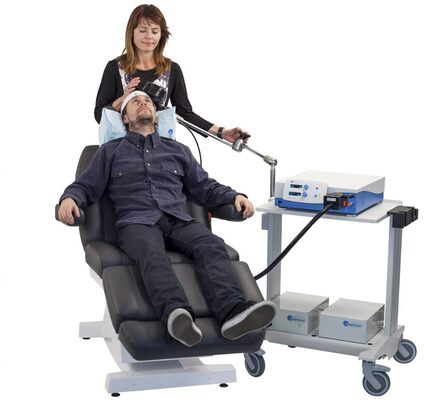
TMS is a procedure that involves the focused application of a magnetic field to regions of the brain to stimulate activity in nerve cells. Patients undertaking TMS usually attend an outpatient clinic for 30-45 minutes a day on a daily basis over four to six weeks. They sit in a comfortable chair whilst the coil is placed over a specific part of the brain. The coil is used to generate strong magnetic pulses which stimulate and activate a small area of the brain underneath the coil. When these pulses are applied repeatedly over days and weeks, they induce changes in brain activity and changes in the strength of connections between brain regions. This procedure is typically very well tolerated with few significant side-effects.
Depression is an extremely common medical condition affecting up to 15% of people across the lifespan. There are a number of widely available treatments for depression, including various medications and a number of types of psychotherapy. Although these treatments are generally effective, a significant proportion of patients with depression, usually about one third, fail to respond to these and have persistent and ongoing problems with depression over long periods of time. Transcranial magnetic stimulation (TMS) is an effective and safe treatment approach for these patients and for other patients who cannot tolerate medications or other standard treatment approaches.
TMS is a procedure that involves the focused application of a magnetic field to regions of the brain to stimulate activity in nerve cells. Patients undertaking TMS usually attend an outpatient clinic for 30-45 minutes a day on a daily basis over four to six weeks. They sit in a comfortable chair whilst the coil is placed over a specific part of the brain. The coil is used to generate strong magnetic pulses which stimulate and activate a small area of the brain underneath the coil. When these pulses are applied repeatedly over days and weeks, they induce changes in brain activity and changes in the strength of connections between brain regions. This procedure is typically very well tolerated with few significant side-effects.
|
What should I expect when having TMS?
The patient may feel a tapping sensation under the coil (this occurs due to a twitch produced in the scalp muscles as the magnetic field crosses into the brain). The magnetic field can also stimulate small nerves around the head and face producing a muscle twitch in the forehead, face or eye region. The stimulation can be applied in a variety of ways: the most common two ways are either as a long train of pulses administered approximately one per second or as short bursts of a large number of pulses administered over a few seconds at a time. If the rTMS is effective in treating depression, this usually takes at least several weeks to start working. Sometimes symptoms will not improve substantially until after a course of treatment is completed: this seems strange but we do see some patients who do not notice much until they have finished treatment: in the weeks afterwards they then notice a gradual improvement in depression. Research has shown that longer courses of TMS produce better responses than shorter ones. Some patients will be well after 4 weeks but some require up to 6 weeks to get a good outcome. Treatment is usually 5 days per week but if this is too hard to manage, doing treatment 4 days, and perhaps 3, per week, is still likely to be helpful. |
How Do You Get Access to TMS Treatment? In Australia, ~ 90% of TMS is currently provided to inpatients in private psychiatric hospitals although it can be safely provided as an outpatient treatment in almost all patients. Professor Fitzgerald is involved in the provision of inpatient and outpatient TMS at the Epworth Hospital in Camberwell, Victoria. He also determines the TMS treatment protocols for TMS Australia. TMS Australia currently has clinics providing TMS in Melbourne CBD, Sydney CBD, Brisbane (Toowong, Booval), Geelong, Narre Warren, Mornington, Sydenham, Keilor East, The Gold Coast, Wagga Wagga and Murrumbateman. 
|
Side Effects
There are several potential side effects that might be experienced during an rTMS procedure. First, a headache or neck-ache can occur, similar to a tension headache, caused by the stimulation of nerves in the scalp. This occurs in approximately five of every one hundred participants and will often improve rapidly with simple pain medication such as ‘aspirin’ or ‘panadol’. Second, the stimulation itself may be uncomfortable and occasionally painful. As the magnetic field passes into the brain, it can cause stimulation of muscles in the scalp causing them to contract. This can feel like a twitch, a tapping sensation or a brief muscle cramp. How strong this feels varies dramatically between subjects: some feel almost nothing and others a stronger sensation. Those who do find it uncomfortable usually find they get used to the sensation over a few days and strength of the stimulation pulse can be lowered until then.
Risks
The main concern associated with TMS is its potential to cause a fit or seizure. Very few seizures have occurred with TMS over the years and in 20 years of doing TMS I have not had a single patient experience a seizure so the risk appears quite low. However, it is possible and TMS needs to be administered carefully to minimise this risk.
TMS has now been used in research and clinically for over 3 decades. Over this time no evidence has emerged that it is associated with any substantial long-term side effects.
There are several reasons why someone may not be usually considered suitable for TMS. These include a diagnosis of epilepsy, an active brain illness such as a recent stroke or anything that may be affected by the magnetic field. This can include metal implants in the head, surgical clips, cardiac pacemakers, implanted medication pumps or electrodes. TMS may also be avoided if a patient has an unstable medical condition (for example heart disease) that could be exacerbated if they were to suffer a seizure. The safety of TMS in pregnancy has not been fully evaluated - it seems safe and the magnetic field is not strong enough to pass to the foetus but it usually lakes a long time before new therapies like TMS have been used in enough pregnant women to establish safety with any degree of confidence.
Other Treatments Whilst undertaking TMS
It is important to tell your doctor about any treatments or medications you may be taking, including non-prescription medications or herbal remedies and any changes to these during your participation with TMS. We typically try and avoid significant changes to medication, or starting new medications that affect the brain, during a course of TMS treatment as this is likely to confuse our understanding about what might have produced any therapeutic benefits with this treatment.
There are several potential side effects that might be experienced during an rTMS procedure. First, a headache or neck-ache can occur, similar to a tension headache, caused by the stimulation of nerves in the scalp. This occurs in approximately five of every one hundred participants and will often improve rapidly with simple pain medication such as ‘aspirin’ or ‘panadol’. Second, the stimulation itself may be uncomfortable and occasionally painful. As the magnetic field passes into the brain, it can cause stimulation of muscles in the scalp causing them to contract. This can feel like a twitch, a tapping sensation or a brief muscle cramp. How strong this feels varies dramatically between subjects: some feel almost nothing and others a stronger sensation. Those who do find it uncomfortable usually find they get used to the sensation over a few days and strength of the stimulation pulse can be lowered until then.
Risks
The main concern associated with TMS is its potential to cause a fit or seizure. Very few seizures have occurred with TMS over the years and in 20 years of doing TMS I have not had a single patient experience a seizure so the risk appears quite low. However, it is possible and TMS needs to be administered carefully to minimise this risk.
TMS has now been used in research and clinically for over 3 decades. Over this time no evidence has emerged that it is associated with any substantial long-term side effects.
There are several reasons why someone may not be usually considered suitable for TMS. These include a diagnosis of epilepsy, an active brain illness such as a recent stroke or anything that may be affected by the magnetic field. This can include metal implants in the head, surgical clips, cardiac pacemakers, implanted medication pumps or electrodes. TMS may also be avoided if a patient has an unstable medical condition (for example heart disease) that could be exacerbated if they were to suffer a seizure. The safety of TMS in pregnancy has not been fully evaluated - it seems safe and the magnetic field is not strong enough to pass to the foetus but it usually lakes a long time before new therapies like TMS have been used in enough pregnant women to establish safety with any degree of confidence.
Other Treatments Whilst undertaking TMS
It is important to tell your doctor about any treatments or medications you may be taking, including non-prescription medications or herbal remedies and any changes to these during your participation with TMS. We typically try and avoid significant changes to medication, or starting new medications that affect the brain, during a course of TMS treatment as this is likely to confuse our understanding about what might have produced any therapeutic benefits with this treatment.